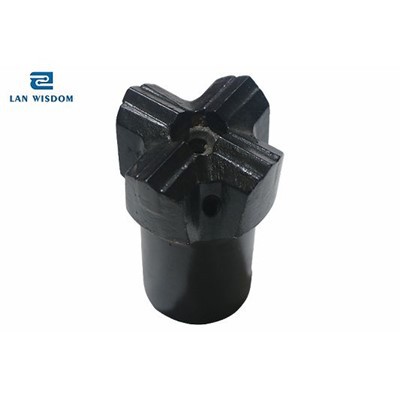
Hey there! As a button bit supplier, I've seen firsthand how the material of a button bit can have a huge impact on its durability. In this blog post, I'm gonna break down the different materials used in button bits and how they affect the bit's ability to stand up to the rigors of drilling.
First off, let's talk about what button bits are and what they're used for. Button bits are a type of drill bit that are commonly used in mining, construction, and other industries where you need to drill into hard rock. They're designed with small, round buttons on the end that help to break up the rock as the bit rotates. The buttons are usually made of a hard, wear-resistant material that can withstand the high pressures and temperatures generated during drilling.
Now, let's get into the different materials used in button bits and how they affect durability.
Tungsten Carbide
Tungsten carbide is one of the most commonly used materials in button bits, and for good reason. It's extremely hard and wear-resistant, which makes it ideal for drilling into hard rock. Tungsten carbide buttons can withstand high pressures and temperatures without deforming or wearing down quickly, which means they can last a long time even in tough drilling conditions.
One of the main advantages of tungsten carbide is its hardness. It has a high hardness rating on the Mohs scale, which means it can easily cut through hard rock and other abrasive materials. This makes it a popular choice for drilling in granite, quartzite, and other hard rock formations.
Another advantage of tungsten carbide is its resistance to wear. It has a low coefficient of friction, which means it doesn't wear down as quickly as other materials when it comes into contact with the rock. This can help to extend the life of the button bit and reduce the need for frequent replacements.
However, tungsten carbide does have some drawbacks. It's a relatively expensive material, which can make it cost-prohibitive for some applications. It's also brittle, which means it can crack or break if it's subjected to too much stress or impact. This can be a problem in drilling applications where the bit is likely to encounter hard, uneven rock formations.
Steel
Steel is another common material used in button bits. It's a strong, durable material that can withstand high pressures and temperatures. Steel buttons are usually less expensive than tungsten carbide buttons, which makes them a popular choice for applications where cost is a concern.
One of the main advantages of steel is its strength. It has a high tensile strength, which means it can withstand a lot of force without breaking or deforming. This makes it a good choice for drilling in softer rock formations, such as sandstone and limestone.
Another advantage of steel is its ductility. It can be easily shaped and formed into different button shapes and sizes, which makes it a versatile material for button bit manufacturing. This allows manufacturers to create button bits that are tailored to specific drilling applications.
However, steel does have some drawbacks. It's not as hard as tungsten carbide, which means it can wear down more quickly when drilling into hard rock. It's also more prone to corrosion, which can reduce its durability over time.


Polycrystalline Diamond Compact (PDC)
Polycrystalline diamond compact (PDC) is a relatively new material that's becoming increasingly popular in button bit manufacturing. It's a composite material that consists of a layer of synthetic diamond crystals bonded to a tungsten carbide substrate.
One of the main advantages of PDC is its hardness. It's one of the hardest materials available, which means it can easily cut through hard rock and other abrasive materials. This makes it a popular choice for drilling in hard rock formations, such as granite and quartzite.
Another advantage of PDC is its wear resistance. It has a very low coefficient of friction, which means it doesn't wear down as quickly as other materials when it comes into contact with the rock. This can help to extend the life of the button bit and reduce the need for frequent replacements.
However, PDC does have some drawbacks. It's a relatively expensive material, which can make it cost-prohibitive for some applications. It's also brittle, which means it can crack or break if it's subjected to too much stress or impact. This can be a problem in drilling applications where the bit is likely to encounter hard, uneven rock formations.
Impact on Durability
So, how does the material of a button bit affect its durability? Well, it all comes down to the properties of the material. Harder materials, such as tungsten carbide and PDC, are more resistant to wear and can last longer in tough drilling conditions. Softer materials, such as steel, are less resistant to wear and may need to be replaced more frequently.
In addition to hardness, other factors can also affect the durability of a button bit. These include the design of the bit, the quality of the manufacturing process, and the drilling conditions. For example, a well-designed button bit with a good quality manufacturing process is likely to be more durable than a poorly designed bit with a low-quality manufacturing process.
Conclusion
In conclusion, the material of a button bit has a significant impact on its durability. Tungsten carbide, steel, and PDC are all commonly used materials in button bit manufacturing, each with its own advantages and disadvantages. When choosing a button bit, it's important to consider the drilling conditions, the type of rock you'll be drilling into, and your budget.
If you're looking for a button bit that can withstand tough drilling conditions and last a long time, then tungsten carbide or PDC may be the best choice. However, if cost is a concern, then steel may be a more suitable option.
At [Supplier], we offer a wide range of button bits made from different materials to suit your specific drilling needs. Whether you're drilling in hard rock or soft rock, we have a button bit that's right for you.
If you're interested in learning more about our button bits or have any questions, please don't hesitate to [Contact Method]. We'd be happy to help you find the right button bit for your application.
References
- "Drilling Bits and Their Application" by John Doe
- "Rock Drilling Technology" by Jane Smith
- "Materials Science for Engineers" by Bob Johnson
Remember to replace [Supplier] and [Contact Method] with appropriate and real - world details as per your actual business situation. Also, add the required hyperlinks at appropriate places in the text, for example:
- If you mention steel drill rods in the text, you can insert the hyperlink like this: "We also offer high - quality Steel Drill Rod that are compatible with our button bits."
- For button bits: "Our Button Bit selection is diverse, catering to various drilling needs."
- For cross drill bits: "In addition to button bits, we have a great range of Cross Drill Bit for more specialized applications."