


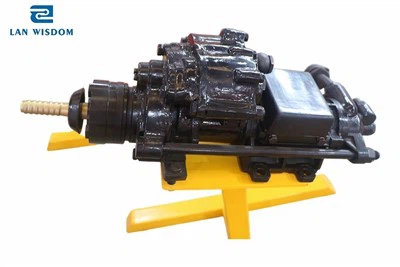
Hydraulic Rock Drill
● Strong power: impact frequency can reach up to 60Hz, maximum output torque can reach 740N·m, output power > 15KW
● Low energy consumption: Hydraulic technology has high energy efficiency, not only reducing operating costs but also being more environmentally friendly and energy-saving.
● Application fields: widely used in open-pit excavation, tunneling, and various rock drilling operations for blasting holes. It is an essential tool for metallurgy, coal mining, railways, transportation, water conservancy construction, and stone engineering, especially suitable for drilling holes in medium-hard or hard rocks (f=8-18) in any direction.
● Quality Assurance: With over 50 years of experience in research, development, and production, as well as strict quality control, we have earned a good reputation in the industry.
product Introduction
Our company's newly developed hydraulic rock drill features high power, low noise, reliable use, strong adaptability, convenient maintenance, and economical rock drilling. It is the ideal rock drilling equipment for coal mines, water conservancy, transportation, urban construction, and other engineering projects. It is most suitable for drilling rock holes in medium-hard or hard rocks (f=8-18) in any direction. The borehole diameter generally ranges from 45 to 89 millimeters, with an effective and economical drilling depth of up to 20 meters. This machine can be installed on fully hydraulic drill rigs, drilling frames, and other auxiliary platforms for operation.
product Parameter (specification)
|
Model TAY138ME |
Model TAY136H |
Model TAY140 |
||
|
Weight |
Kg |
172 |
175 |
192 |
|
Dimensions (length × width × height) |
mm |
1162 × 250 × 235 |
1034(1163)×253×230 |
1375(1145)×318×235 |
|
Center height |
mm |
85 |
88 |
85 |
|
Impact of work pressure |
bar |
140-220 |
140-230 |
140-220 |
|
Impact frequency |
Hz |
40-60 |
40~60 |
40~50 |
|
Impact power |
KW |
>18 |
18 |
>15 |
|
Impact oil flow |
L/min |
≤90 |
75-92 |
≤90 |
|
The flow rate of hydraulic oil |
L/min |
65 |
65 |
65 |
|
Output maximum torque |
N·m |
740 |
740 |
|
|
Rotational speed |
r/min |
0-300 |
0~300 |
0~300 |
|
Borehole diameter |
mm |
Φ45-89 |
Φ38~64 |
Φ65~130 |
|
Economic drilling depth |
m |
20 |
20 |
20 |
|
Piston stroke (max) |
mm |
65 |
65 |
68 |
|
Rinsing water medium pressure |
bar |
5.5-18 |
5.5~18 |
5.5~18 |
|
Lubricated air pressure |
bar |
2-4 |
3~6 |
2~4 |
|
Brazing tail specifications |
T38 |
R32\R38\T38 |
T38\T45\T51 |
|
|
Drill bit diameter |
mm |
Φ45-89 |
φ38~64 |
φ64-127 |
|
Rock drilling thrust |
kgf |
500~1450 |
||
|
Rotary motor model |
OMS160 |
Product feature and application
Product features:
Lubrication and sealing system: Ensuring internal components are protected from wear and external contaminants.
The working environment has significantly improved: hydraulic rock drills produce about 10 decibels less noise than pneumatic rock drills and eliminate oil mist at the work site, greatly enhancing the working conditions for operators.
The equipment is durable and has a longer lifespan: Due to its advanced working principle and structure, the key components of hydraulic rock drills, such as the impact piston, can last up to three times longer than those of pneumatic rock drills. The overall failure rate is low, and the machine has a long service life.
Flexible operation and strong adaptability: centralized operating mechanism, easy to use, conducive to intelligent control, excellent mechanical performance suitable for various complex environments.
Application fields:
In the field of engineering: widely applied in earth and stone works, demolition works, road and bridge works, tunnel excavation works, (non-)excavation works, water conservancy projects, etc.
Mining sector: applicable to stone quarrying (such as marble, granite, sandstone, limestone, etc.), metal ore mining, coal mining, sand and gravel quarrying, etc.
Other fields: It can also be used for drilling blast holes in reinforced concrete and plain concrete.
Product details
Highly efficient and stable: It integrates cutting-edge engineering technology from the industry, maintaining outstanding operational smoothness and excavation performance under high-frequency, high-impact conditions. This effectively addresses common issues of performance degradation and energy consumption during operation, providing more powerful and forceful impacts.

The powerful torque provided by hydraulic technology effectively reduces the risk of drill rod sticking during drilling, ensuring continuous and stable operation. The impact stress waves it generates are closer to rectangular waves, which also helps extend the lifespan of the drill rods.

Hydraulic technology, precision forging, and CNC machining ensure its excellent mechanical properties.
Function and status detection: Our assurance comes from our meticulous control over details. Through our rigorous testing, you don't need to worry about unknown quality risks in the future.

why choose us?
1.High-performance rock drilling, improve work efficiency
The energy efficiency conversion rate is high, with performance metrics improved by 15%-20% compared to similar products. Drilling is faster, significantly advancing project timelines, and productivity per unit time is higher.
2.Significantly reduce energy consumption costs
High energy efficiency (hydraulic rock drills generally reach over 40%, far exceeding the 10% of pneumatic rock drills), with power consumption only about one-third of that of pneumatic rock drills with equivalent performance, significantly reducing operating costs.
3.The lifespan of critical components has been significantly extended.
Adopting an optimized slender piston design reduces the peak stress on the drill rod, which helps to extend the drill rod's lifespan, results in fewer equipment failures, shorter downtime, lower costs for consumables such as drill bits, and an overall more favorable total cost of ownership (TCO).
4.Significantly improved the work environment.
Lower noise levels, elimination of oil mist at the work surface, improved working conditions for operators, compliance with environmental protection requirements, and benefits for occupational health and safety.
5.Higher intelligent adaptation
The impact energy and rotation speed can be conveniently adjusted according to the rock conditions to obtain the optimal drilling parameters, adapting to different strata and maintaining high efficiency continuously, with greater operational flexibility.
FAQ
Q: What are the operating procedures for hydraulic rock drills?
A: Before starting a new rock drill or a rock drill that has recently undergone major maintenance, you should:
- Hose
- inflate the accumulator
- Choose the appropriate hydraulic oil and lubricants.
- Lubricate the lubrication system with lubricating oil.
- regulate and set up the lubrication system
- Set buffer pressure
- Each shift should:
- Verify if there is any air and lubricating oil leaking from between the brazing tail and the guide sleeve, as well as from the front-end hole.
- Verify if the pressure gauge reading of the buffer on the drilling platform is normal. Adjust the buffer pressure when there is a deviation.
- Check if the drill tail thread connection is intact.
- Check the hydraulic hoses; if they vibrate excessively, inspect the accumulator.
- Check for leaks in the rock drill. If the flushing medium is leaking from the overflow hole, the seals should be replaced.
- When replacing the drill tail drive sleeve or removing the front end, check the internal components, including the piston, drill tail sleeve, and visible parts of the drive mechanism. If there are defects, send them to the appropriate workshop for repair or replacement.
- After the first shift of using a new or recently overhauled rock drill, the following should be done:
- Every 40 impact hours:
- Lubricate the gears with grease.
- Tighten all threaded unions.
- Check the safety label on the accumulator. If it is damaged or unreadable, it should be replaced.
- Check the return oil buffer accumulator.
- Every 400 impact hours:
- Remove the rock drill from the drilling platform and send it to the appropriate workshop for major repairs (since the characteristics of the rock will greatly affect the wear rate, major repairs should be carried out at suitable intervals based on local conditions).
Q: How to properly store hydraulic rock drills for long-term preservation?
A: If a rock drill is not used for a long time, the following preventive measures should be taken:
- Verify that all fittings, including those used for flushing media, are properly capped or covered, and ensure that the protective caps or covers are of the correct size.
- Thoroughly clean the rock drill, rinse the rock drill with degreaser and tap water.
- Thoroughly clean the nozzle components that come into contact with the cleaning agent. This step is particularly important in areas with high humidity. After cleaning, apply clean lubricating oil to the components.
- bleed the accumulator
- Store the rock drill in a dry place.
Hot Tags: hydraulic rock drill, China hydraulic rock drill manufacturers, suppliers, factory, yt29a rock drill, Hydraulic Rock Drill
Previous
YT28 Rock DrillYou Might Also Like



Send Inquiry